
Subscribe to the blog and receive recommendations to boost your CX
Working in the insurance sector today means living with several challenges at the same time. On one hand, acquiring customers is increasingly complicated: there is more supply, more channels, and customers are much more demanding. On the other hand, when volume grows, offering excellent service at a large scale becomes a genuine operational challenge.
Added to this is the need to retain, renew, and monetize the portfolio, because in insurance it is not enough to acquire: the real value lies in the long term. And, of course, all this without losing sight of complying with regulation and guaranteeing traceability, without the operation becoming slow or rigid.
In this context, the CRM can no longer be just a sales tool. It has to become the axis that connects acquisition, service, and compliance. And here arises the big question: what must an insurance CRM have today?
1. Massive and omnichannel operation to acquire at scale
When the goal is to grow, the challenge is usually not launching a campaign, but carrying out many, at the same time, without losing control. In insurance, where an important part of the sale is digital and competition is tight, the CRM must behave like an orchestrator: it coordinates channels, measures performance, and activates contact without friction.
Massive outbound and integration with the contact center
To acquire at scale, the CRM needs to be able to control outbound campaigns at a good pace, but without losing traceability. That is where Infunnel fits especially well: it connects with the contact center to orchestrate massive campaigns, whether you work with Inconnect or operate with a third-party platform.
A real example of how a large insurer transformed its service model with an omnichannel vision. Discover it here

The practical advantage is twofold:
- You scale contact via call without depending on manual tasks (lists, dialing, or follow-up).
- You open the door to real omnichannel capability, also automating impacts by SMS or email, so that the contact advances through the most effective channel.
In insurance, this is fundamental because many campaigns require cadences (several attempts, different channels, different messages) and the CRM has to sustain that volume consistently.
Contact automation: agile inbound telemarketing
In digital acquisition, speed is the main asset: when a lead enters, the important thing is that it does not get cold. Therefore, an insurance CRM connected to the contact center like Infunnel allows operating a very agile inbound telemarketing. The lead arrives and the system automatically triggers the call order to the team, so that waits and jumps between different tools are avoided. In the end, it is about applying inbound telemarketing strategies to respond sooner, prioritize better, and convert more without adding complexity to the operation.
Complete funnel from lead to policy
Acquiring is not just generating leads, but converting them into policies with the lowest possible cost. Therefore, an insurance CRM has to measure the complete traceability of the contact, from the moment the lead is generated until it becomes a customer.
This becomes even more important when a key part of acquisition is digital and competition is high, because without that visibility it is very easy to invest in volume but not know what is truly working.
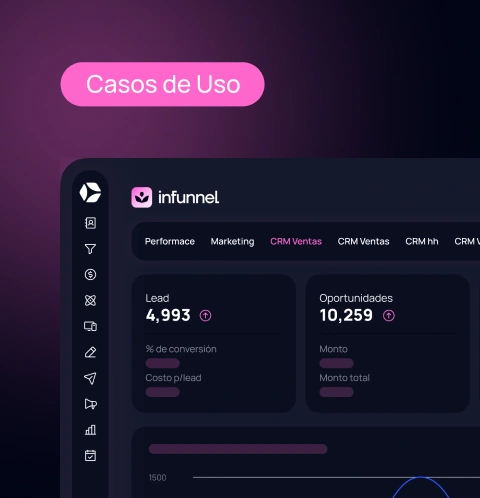
This is what the customer journey looks like when marketing, data, and automation work in the same flow. View Infunnel demo
2. CRM + contact center integration to provide excellent service
Good service depends on the CRM and contact center working as a single system. And for that to truly happen, there are three key points that cannot fail:
- Frictionless inbound operation: the CRM must have the capacity to manage large volumes of contacts, dispatches, and flows in parallel, especially during peaks, without becoming slow or adding manual work.
- Automatic flow and intelligent routing: each interaction enters with context and is directed to the appropriate team from the first moment (claims, assistance, renewals, or collections), with logic typical of a CRM connected to the contact center that identifies, registers, and automatically routes the calls.
- Unified data for sales and service: when both teams work on the same information, duplicities are avoided and the management of sensitive processes is facilitated, such as automating portfolio recovery with traceability and coordinated cadences.
3. 360 view of the insured for contextual service
Service works better when the team has context and access to the complete history of the customer or prospect from the first moment. An insurance CRM like Infunnel, for example, is capable of unifying that history even if the customer has contacted through different channels.
And when that view gathers data from all contact points, what happened in acquisition is not lost when the customer calls. That traceability, moreover, fits with the need to optimize CAC (customer acquisition cost), because it connects origin, journey, and result to make decisions with better judgment.
How to optimize key processes in insurance and reduce operational burden without compromising service quality.
Discover the use case

4. Intelligent automation for retention, renewals, and portfolio profitability
Automation helps renewals, notices, and incident follow-ups activate themselves, with reminders and communications that arrive when they have to arrive, without depending on manual tasks.
On that basis, the insurance CRM also facilitates more accurate upselling and cross-selling campaigns, activated at the right moment and with messages consistent with the history and context of the insured.
And in the most sensitive part, which is collections, working with CRM automations designed for collection management allows ordering the process, prioritizing, and improving recovery without adding friction to the relationship with the customer.
5. Security and compliance to meet regulations without slowing down the operation
In the insurance sector, security and regulatory compliance are part of the service. Many contracts are made by phone and that requires being able to demonstrate, with data, that the process has been carried out correctly. Therefore, an insurance CRM like Infunnel can connect with Speech Analytics solutions like Inspeech, leaving a record of the conversations and providing clear evidence for any review.
Added to this layer is information protection. By integrating into the Inconcert ecosystem, Infunnel complies with GDPR and with the main security standards, backed by certifications that endorse cybersecurity and data protection.
When the CRM stops being a tool and becomes the engine
When the insurance CRM is well planned, it becomes the business orchestrator: it connects acquisition, contact center, after-sales, renewals, and collections with a unique view of the customer. Therefore, when choosing technology in insurance it is advisable to select a platform that supports the long term without forcing you to redo processes every time the business changes.
If you want to see how this translates into the day-to-day, Infunnel as an insurance CRM allows centralizing the commercial funnel, automating campaigns and workflows, and connecting the operation with the contact center so that acquisition and service advance with the same rhythm (and the same context).
You can request a demo whenever you want and we will see it applied to your insurance operation.