Subscribe to the blog and receive recommendations to boost your CX
The telephone is once again at the center of the regulatory debate. Following Spain’s Customer Service Act (Ley SAC) and other measures against spam and caller ID spoofing, companies that make marketing calls now face a new requirement: the use of the 400 prefix. The resolution published in Spain’s Official State Gazette (BOE) assigns the 400 range to outbound marketing calls and establishes that these numbers will help users identify this type of communication before answering. In addition, 400 numbers will be outbound-only, meaning they cannot receive incoming calls and users will not be able to call the same number back.
For any company running outbound campaigns, this represents a major change. For a high-volume contact center, the impact is even greater: teams will need to review which campaigns are considered marketing, which phone numbers they use, how Caller ID is configured, what happens when a customer tries to return the call, and which alternative channels can keep the conversation going.
Are your campaigns already compliant with the 400 prefix?
Request a free demo
What is changing with the 400 prefix in Spain
Starting in October 2026, companies subject to the requirement will have to make marketing calls from nine-digit numbers beginning with 400. The Spanish government has stated that, once the transition period ends, telecom operators will block marketing calls that do not originate from the assigned number range.
The goal is to create a clearer separation between marketing calls and customer service, support, or after-sales calls. This distinction will be essential when deciding which number range each company should use for each type of call.
Marketing calls will have to originate from 400 numbers, while customer service calls must use specific short codes, toll-free 800/900 ranges, or geographic numbers. The rules also specify that mobile numbers must not be used for customer service calls.
Every outbound call flow will need a clear Contact Center category
Before changing phone numbers or configuring dialers, contact centers should map every outbound call flow: acquisition, cross-selling or upselling to existing customers, collections, surveys, support, renewals, after-sales follow-up, appointment confirmations, and customer win-back.
Some cases will be straightforward. For example, a campaign designed to sell a product to new customers must originate from a 400 number. However, mixed-purpose scenarios, such as retention calls that include a sales offer, after-sales follow-up with an expansion proposal, or collections calls that involve negotiation—should be reviewed with legal counsel and the technology provider to determine the correct treatment.
This review will be especially important for campaigns that are not purely marketing-related, such as surveys, collections, or communications with existing customers. In these cases, companies should analyze the actual purpose of the call, the available consent, and the most appropriate channel before deciding whether the call falls within the 400 framework.
Optimize Your Campaigns for the 400 Prefix With Inconnect.
Download the product sheet

What your contact center should review before october 2026
Adapting to the 400 prefix affects several layers of the contact center. Before the change becomes mandatory, review the following:
- Outbound phone numbers: Obtain 400 numbers, define which campaigns must use them, and correctly configure caller identification.
- The automatic dialer: Make sure each campaign uses the appropriate number and that marketing traffic remains separate from customer service, support, or follow-up calls.
- 400 number management: Plan how many numbers will be needed, which campaigns will use each one, and how they will be organized to avoid relying on a single number for high-volume campaigns.
- Coordination between telephony and software: Working with a provider that combines both layers makes it easier to manage phone numbers, campaign configuration, response channels, reporting, and traceability from a single environment.
- The response strategy: If a user does not answer a marketing call or cannot call a 400 number back, the contact center needs other ways to continue the conversation, such as WhatsApp, SMS, email, forms, call-me-back options, or inbound calls. An omnichannel solution that centralizes every contact channel can make this much easier.
Turn the 400 prefix into a sales advantage with Inconnect.
Request a demo
Branded calls: a layer of trust for marketing calls
One of the biggest challenges for marketing calls will be getting users to answer. If the 400 prefix identifies the call as marketing-related, companies will need to build trust from the very first second.
This need is already on the radar of leading industry analysts. Gartner, in its report CSP Insight: combat fraud with branded calling and messaging services, notes that the growth of AI and concerns about spam calls are driving demand for solutions that can authenticate, protect, and strengthen trust in business communications.
Solutions such as Branded Calls allow customers to identify a call before answering by displaying the company name and, when possible, additional information such as the reason for the call or the company logo.
For companies, this identification can help build trust from the first second and reduce the constant rotation of phone numbers. At a time when users are becoming increasingly selective about which calls they answer, displaying the brand can become an important competitive advantage.
Add branded calls to your Contact Center strategy.
Request a demo
From mass outbound calling to intelligent, omnichannel outbound engagement
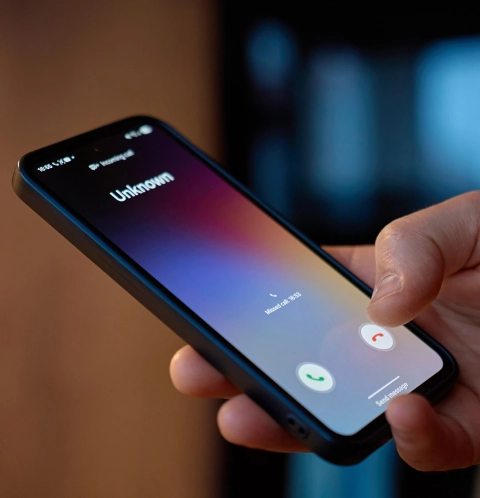
The 400 prefix also requires companies to rethink their dependence on outbound calls. If a campaign relies only on voice, any drop in answer rates directly affects performance. The better approach is to design the journey more effectively: combine calls, SMS, WhatsApp, email, or call-me-back options based on timing, user intent, and the value of each contact.
WhatsApp Business Calling makes the most sense when the call is initiated by the user. It does not replace an outbound campaign with a dialer, but it does create a useful option: customers can move from WhatsApp to a call when they need more information or assistance to complete a process. This would form part of an inbound telemarketing strategy. Within Inconnect, this journey can provide a path back to the conversation when a marketing call from a 400 number goes unanswered.
AI agents are also beginning to play a role in these processes. For example, they can qualify responses, resolve repetitive questions, collect data before transferring the conversation, or support human teams when an interaction requires sales judgment. To understand this shift, it is useful to view agentic AI as a way to coordinate decisions, tasks, and actions within real-world processes, rather than as a simple conversational layer.
As the interaction progresses, Inagent makes it possible to add AI agents to customer service, sales, or follow-up processes, with human oversight and contextual transfer when the conversation needs to move to the team. In complex campaigns, this approach can be supported by multi-agent systems that coordinate specialized agents for different tasks, from initial qualification through closing or routing.
Prepare your contact center for the new regulatory framework.
Request a demo

Regulation Is pushing Contact Centers toward more traceable models
The 400 prefix, the Ley SAC, and anti-spam measures are intended to bring greater order to communications between companies and users.
Contact centers will need to review much more than their phone numbers. They must correctly classify each flow, separate customer service from sales, document permissions, ensure traceability, and combine channels intelligently. The first decision is to understand which number range each company should use for each type of call, especially when marketing, support, follow-up, collections, and loyalty campaigns coexist.
The next step is to address the technical layer: telephony, dialers, Caller ID, CRM, reporting, and response channels. At this stage, it is advisable to plan ahead and review how to prepare business communications systems for the 400 prefix before the change becomes mandatory.
The transition should not be handled in isolation. Work on the 400 prefix is directly connected to the requirements of the Ley SAC, so companies should move forward on both fronts to prepare their contact centers for this new framework.
How to prepare with Inconnect, Inconcert’s Contact Center solution
Preparation for the 400 prefix should begin as soon as possible. These are the most important steps to take:
- Classify every outbound flow by purpose: marketing, customer service, support, collections, surveys, follow-up, or mixed.
- Identify which campaigns must originate from 400 numbers and which should remain on customer service number ranges.
- Review the configuration of dialers, Caller ID, lists, CRM, and reporting.
- Define response channels for customers who cannot return calls to 400 numbers.
- Consider Branded Calls to strengthen trust and improve answer rates.
- Design omnichannel journeys using SMS, WhatsApp, email, call-me-back options, or inbound calls through WhatsApp Business Calling. In this area, the capabilities of Infunnel combined with Inconnect create a wide range of possibilities for preparing the strategy.
- Measure results and optimize campaigns based on contact rates, costs, response, and conversion.
The 400 prefix should not be treated as a simple phone number change. In practice, it requires companies to review the contact strategy for their outbound campaigns. The sooner this review is completed, the easier it will be to avoid blocked calls and maintain sales effectiveness.
With Inconcert, companies can move through this transition by combining telephony, contact center software, digital channels, and AI agents within a single environment. Request an Inconnect demo and discover how to prepare your campaigns for the new 400 prefix landscape.
Review your outbound strategy before the 400 prefix takes effect.
Request a demo
Frequently asked questions about the 400 prefix and Contact Centers